
Clubbers’ Decktionary: Krautrock
22 February 2012
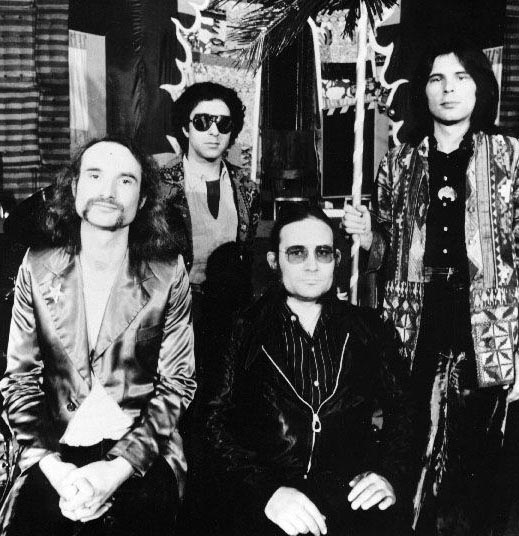
Krautrock, proper noun
Eclectic style, originally German, mostly instrumental and usually combining a traditional rock band line-up (guitars, bass, drums) with electronic instruments; often characterised by a four-four time signature and stripped-back productions with the emphasis on the rhythm section employing mechanical, propulsive drum beats and repetitive bass phrases.
Origins: The experimental classical works of Karlheinz Stockhausen, the loop experiments of La Monte Young, Terry Riley and Steve Reich, the free jazz of Ornette Coleman and Albert Ayler and the psychedelic traditions of the late Sixties were all precursors to the ‘krautrock’ movement, 1968 – 1974. Initially operating completely independently of one another in Berlin, Cologne, Munich and the Wümme region, the bands infamously dubbed with this disparaging epithet by the British press (they preferred to talk about ‘kosmische’ musik themselves) were generally unified in their desire to break with the traditions and song structures of blues-based rock ‘n’ roll, while retaining its energy. It was as much a reaction against the cultural void that existed in West Germany after the war as a rejection of British and American pop-cultural values, to express something uniquely German.
Key figures: Can (pictured above), Faust, Neu!, Amon Duul, Ashra Tempel, Popul Vuh, Kraftwerk, Kluster/Cluster, Harmonia (who were effectively a krautrock ‘supergroup, including Neu!’s Michael Rother, Dieter Moebius and Hans-Joachim Roedelius of Kluster and, for a brief period when they were recording their third album, Brian Eno) and Tangerine Dream. Half of these bands at some point worked with celebrated Cologne-based producer/engineers Conny Plank and Dieter Dierks (formerly an actor, initially part of Ash Ra Tempel and Tangerine Dream and later behind Scorpions). John Peel was an invaluable supporter in terms of UK airplay and myriad contemporary acts have acknowledged the influence, including Radiohead, Stereolab, Deerhunter, The Horrors, Tortoise, The Mars Volta, Wilco, The Secret Machines, Mouse On Mars, Of Montreal, Fujiya & Miyagi and The Invisible.
This feature was originally published in August 2011 by The List magazine. It has been reproduced with their permission.
N.B. London’s evergreen Soul Jazz label have released a great compilation, titled Deutsche Elektronische Musik and dedicated to experimental German rock and electronic sounds, 1972 – 1983. It’s an excellent intro to this obscure scene.

